Cart
0
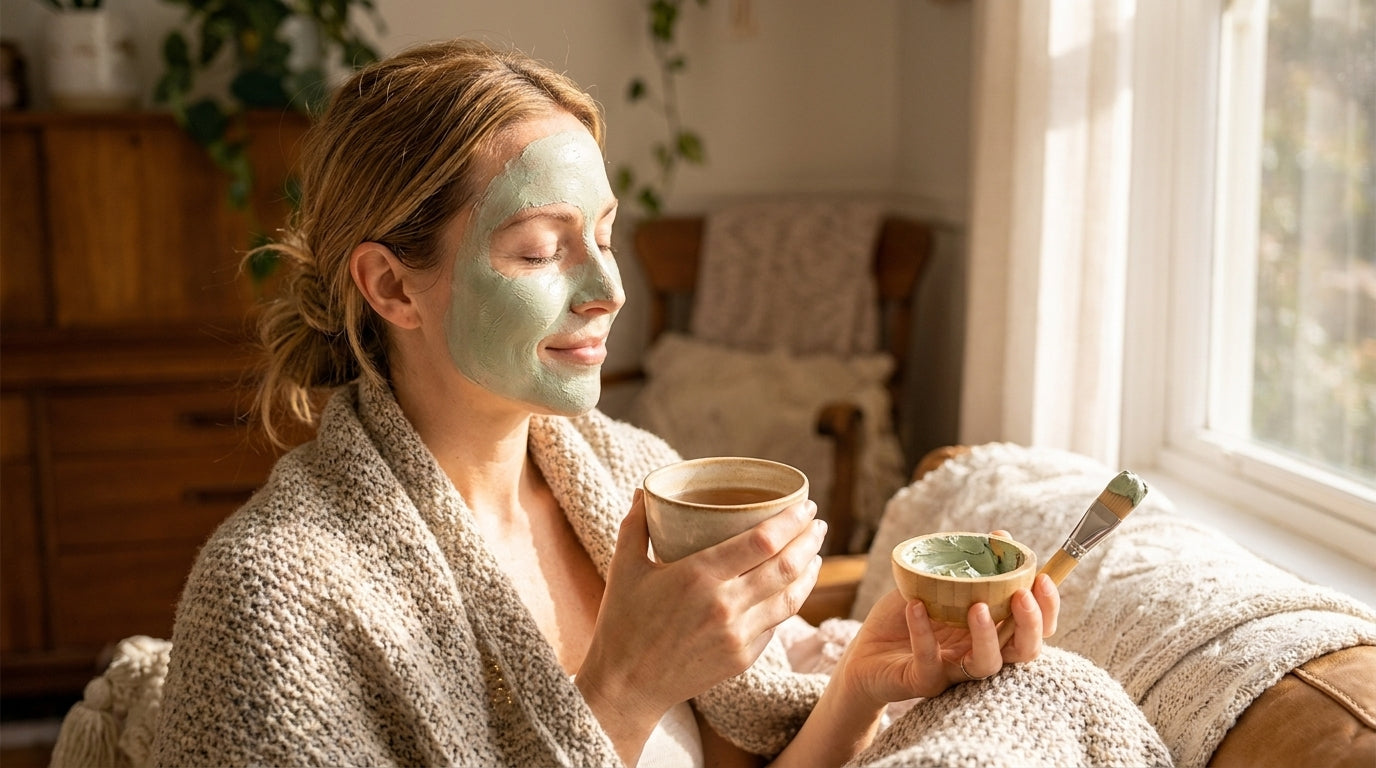
Kaolin and bentonite are the two clays you will meet most often in natural skincare, and they are not interchangeable. One is a gentle, near-neutral clay that most skin tolerates several times a week. The other is a strongly alkaline, high-absorbency clay built for oily, congested skin. Choosing the wrong one is the most common reason a clay mask leaves skin tight, red or stripped.
Here is the side-by-side comparison, with the numbers sourced.
Kaolin vs bentonite clay at a glance
| Kaolin clay | Bentonite clay | |
|---|---|---|
| Best for skin type | Dry, sensitive, redness-prone, normal and combination | Oily, congested and acne-prone |
| Absorbency | Low. Cation exchange capacity of kaolinite is 3 to 15 meq/100g, and it does not swell in water | High. Cation exchange capacity of montmorillonite is 80 to 150 meq/100g. Under the USP swelling test, 2g swells to at least 24mL in two hours |
| pH | 6.8, close to neutral | 9.5 to 10.5, strongly alkaline |
| Texture | Soft, fine, silky. Mixes to a smooth paste | Coarser and gritty. Thickens and gels as it hydrates |
| Best use | Regular masking, up to two or three times a week. Gentle exfoliation and everyday oil balancing | Occasional deep cleanse, or spot-applied to the oiliest areas only |
| Sensitivity risk | Low. Its pH sits nearest to skin's own, which is naturally below 5 | Higher. The alkalinity and strong absorbency more often leave skin feeling tight, dry or stripped |
Sources: kaolin pH from the WA Kaolin Product Information Sheet, grade K99-S, Rev J, 6 February 2024, the grade used in our own clay. Bentonite pH and swelling from the United States Pharmacopeia and National Formulary Bentonite monograph. Cation exchange capacities from published clay mineralogy reviews. Skin surface pH from Lambers et al., International Journal of Cosmetic Science, 2006.
Where each clay comes from
Kaolin clay, sometimes called China clay, is a soft white clay made up mostly of the mineral kaolinite. It forms as aluminium silicate minerals weather in place. Our own kaolin is mined and processed at Wickepin in Western Australia by WA Kaolin, an ASX-listed Australian producer, from a primary deposit. A primary deposit is one where the clay has stayed where it formed rather than being washed downstream and mixed with organic matter along the way, which is why it arrives clean.
Bentonite clay forms from weathered volcanic ash and is composed largely of montmorillonite. It is named after Fort Benton in Wyoming. Its structure holds calcium, magnesium, sodium and iron, and it is that structure which gives it the swelling and exchange behaviour kaolin does not have.
What clay actually does on skin, and what it does not
Clay masks are widely described as detoxifying, or as drawing toxins out of the body through the skin. That claim is worth correcting, because it is the one most often repeated and the one least supported.
What a clay mask does is adsorb: oil, sweat and loose surface debris bind to the clay particles and are lifted away when you rinse. Bentonite does this more aggressively than kaolin because it has far more exchange sites available, which is exactly what the cation exchange figures in the table above describe. That is a surface effect. Clay does not draw systemic toxins out through the skin, and no clay mask is a detox.
This matters practically, not just semantically. If you choose a clay expecting it to purge something from deep in your system, you will reach for the strongest one you can find. If you choose it to manage surface oil, you will match the clay to how much oil you actually have, which is the choice that leaves skin comfortable.
Which clay is right for your skin?
Dry, sensitive or redness-prone skin: choose kaolin clay. At pH 6.8 it is the closest of the two to your skin's own pH, it does not swell, and it lifts surface oil without stripping. It is the base of every Eliézer Clay mask for this reason.
Oily or acne-prone skin: bentonite suits a deeper, less frequent cleanse, and works best applied only to the areas that actually need it. Many people with oily skin still prefer kaolin for regular use and keep bentonite for occasional treatments.
Not sure: start with kaolin. It is the lower-risk option, and it is far easier to add strength to a routine than to repair a stripped barrier.
If you want to try it, the hibiscus and kaolin anti-aging mask recipe is the simplest place to start, and adding essential oils to a DIY kaolin mask covers how to adjust it for your skin.
Frequently asked questions
Is kaolin clay the same as bentonite clay?
No. They are different minerals with different behaviour. Kaolin is made of kaolinite, sits at about pH 6.8, and has a low cation exchange capacity of 3 to 15 meq/100g. Bentonite is made of montmorillonite, sits at pH 9.5 to 10.5, swells substantially in water, and has a cation exchange capacity of 80 to 150 meq/100g. Kaolin is the gentler of the two by a wide margin.
Kaolin or bentonite clay mask: which should I use?
Match it to your oil level, not to how powerful the clay sounds. Use a kaolin mask if your skin is dry, sensitive, normal or combination, or if you want to mask more than once a week. Use a bentonite mask if your skin is genuinely oily or congested, and keep it to an occasional treatment rather than a routine step.
Bentonite or kaolin clay for sensitive skin?
Kaolin. Its pH of 6.8 is far closer to skin's own surface pH, which is naturally below 5, than bentonite's 9.5 to 10.5. It also does not swell or grip the way bentonite does. Bentonite's combination of high alkalinity and high absorbency is the usual reason a clay mask leaves sensitive skin tight or red.
Kaolin clay vs bentonite clay for skin: what is the main difference?
Strength. Bentonite absorbs roughly ten times more by cation exchange capacity and is around three pH points more alkaline. That makes bentonite the better choice for heavy oil and kaolin the better choice for everything else, including frequent use. Neither clay detoxifies. Both work on the skin's surface.
Can I use kaolin and bentonite together?
Yes, and blending is a reasonable way to soften bentonite's effect while keeping some of its oil absorption. Start with a majority of kaolin and adjust from there. Mix with water or a hydrosol rather than anything acidic, and rinse before the mask dries hard and cracks, which is when tightness usually sets in regardless of which clay you used.
Prefer the gentle clay?
Our pure Australian Kaolin Clay is the base of every Eliézer Clay mask, mined and processed in Western Australia. For sensitive or redness-prone skin, the Calming Bundle, kaolin with matcha, is the easiest place to start. Free shipping on orders over $80.
Last updated 10 August 2026.